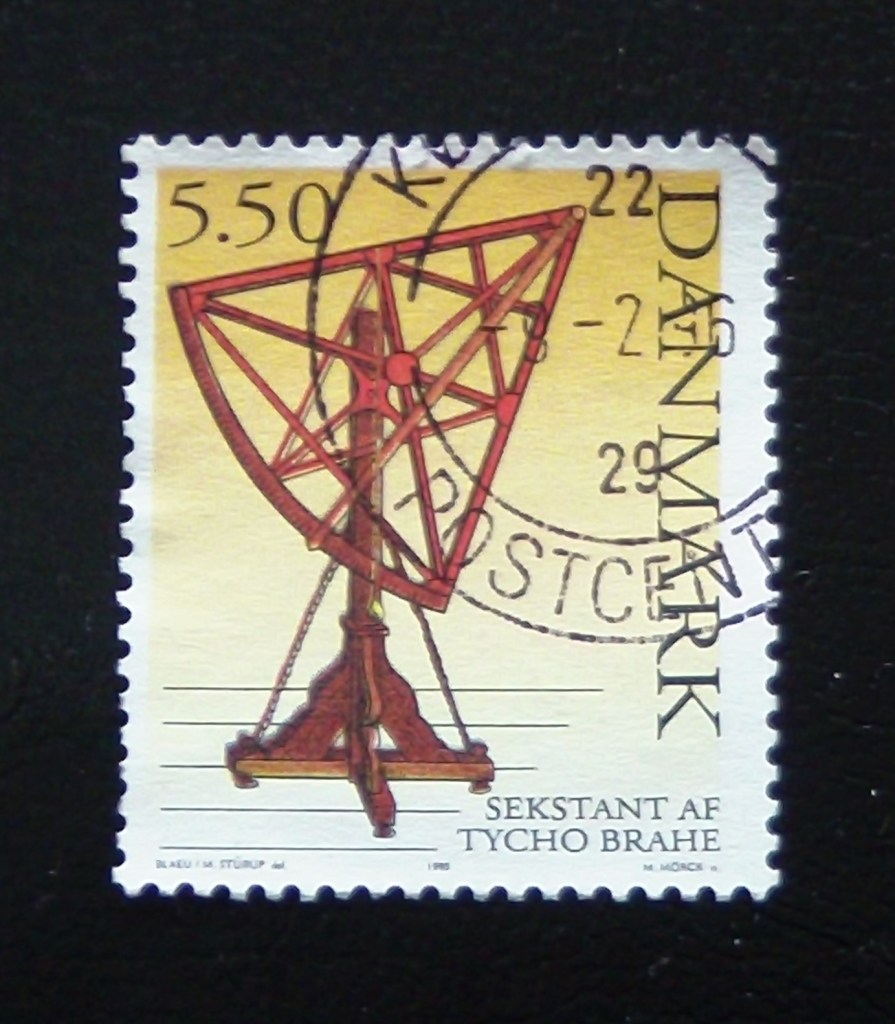
Here we have a Danish stamp from 1995 depicting a framed sextant and commemorating the 450th anniversary of the birth of Tycho Brahe.
The framed sextant, prior to the use of the telescope, was a rather large device used for measuring angular distances of celestial objects. By the sixteenth century this was old technology, with the earlier known examples having been constructed in Iran in the tenth century.
Tycho Brahe himself is probably best described as “a bit of a character”. Born in 1546 in the then-Danish Scania, Tycho dabbled in both astronomy and alchemy. When I say he dabbled in astronomy, I mean on a level of creating-your-own-model-of-the-universe dabbling. Tycho’s model – the Tychonic system – sought to reconcile the mathematics of the Copernican system with the philosophy of the Ptolemaic system.
He also discovered a supernova and, through cunning mathematical dabbling, proved that said object had to be beyond the range of the moon and thus beyond the “celestial sphere” which supposedly comprised the visible universe.
Suffice to say, Tycho took his mathematics seriously. How seriously? Allow me to offer an example. In 1566, Tycho was studying in Rostock. He fought a duel with another student and lost part of his nose (don’t worry, we’ll follow the nose shortly). The reason for the duel was in order to settle a dispute not pertaining to romance or politics, but instead pertaining to the finer points of mathematics.
Back to the nose. As far as I am aware, it was not kept for posterity. However, Tycho did have a prosthetic nose (reputedly made of gold), which he wore – glued in place – for the rest of his life. More on the new nose momentarily, but first we have a death to cover.
In his latter years, Tycho lived in exile in Prague. He died in 1601 and, at the time, his cause of death was said to be kidney stones. Since then, other suggestions of a cause of death have been put forward including mercury poisoning (either through murderous means or the haphazard alchemical dabblings of Tycho himself).
An autopsy following his first (yes, first) exhumation in 1901 ruled out kidney stones. A second examination followed a second exhumation in 2010 also ruled out poisoning by mercury or any other toxin and thus murder. They did, however find rather more gold than might have been expected in Tycho’s beard. However, it was later discovered (from the examination of a bone fragment) that Tycho’s nose was, in fact, brass.
 Second-Class Hero